Will AI Become Public Infrastructure Like Electricity and the Internet?
As AI becomes a capability every sector depends on, the important questions shift from model performance to access, rules, cost and responsibility. Electricity, the internet and public compute point to three plausible futures.
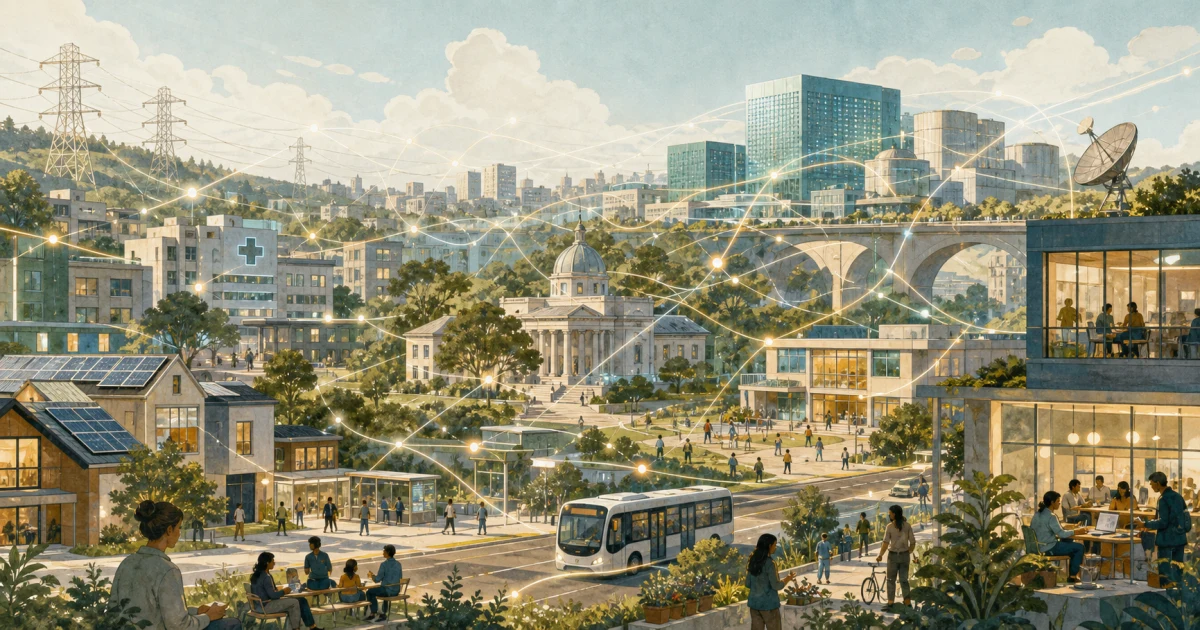
We are accustomed to thinking of AI as a product: a chat window, a subscription, a feature inside another piece of software, or a model API sold by a small number of companies.
Over a five- or ten-year horizon, that framing may prove too narrow.
When hospitals use AI to interpret information, schools use it to support individualized learning, companies place it inside nearly every workflow, and governments rely on it to deliver public services, AI is no longer merely a tool that some people choose to buy. It begins to look like a general capability that every institution must be able to access and every system must learn to govern.
The central questions then change. Who can obtain that capability reliably? Who sets the price? Who is responsible when service fails? Will researchers, smaller firms, remote communities and ordinary citizens have meaningful access? When AI becomes part of health care, education, justice or energy, who gets to set the rules?
In other words: will AI move from a fiercely competitive product category toward something society depends on in the way it depends on electricity and the internet?
This essay does not assume the answer is yes. Infrastructure does not necessarily mean state ownership or free service, and it certainly does not guarantee equal access. Infrastructure can be publicly financed, privately operated, collaboratively maintained or captured by a handful of platforms. The more useful task is to identify which layers of AI are acquiring infrastructural characteristics and which are likely to remain competitive markets.
Defining the question: AI is not a single pipe
The electricity analogy is compelling. Users do not need to know how a generator works. They flip a switch and receive a standardized unit of energy. Companies may eventually consume intelligence in much the same way, buying it by use rather than training models themselves.
But the analogy is only partly right.
Electricity is relatively interchangeable and measurable. Once power from different generators enters a grid, the worldview of the generator does not change what your refrigerator decides to do. AI output is shaped by model design, training data, policy constraints, language, culture and context. The same question can receive different answers from different models. The same model can have radically different consequences inside different institutions.
AI infrastructure therefore has at least five layers:
- Energy and land: electricity, water, networks, cooling and suitable sites.
- Chips and compute: advanced processors, memory, interconnects and large clusters.
- Models and toolchains: foundation models, open weights, training frameworks, evaluations and safety tools.
- Access and allocation: APIs, cloud services, public compute, prices and eligibility.
- Institutions and trust: accountability, privacy, transparency, appeal rights and continuity for critical systems.
Some layers may resemble roads built with public investment. Others may resemble cloud platforms. Still others may look like Linux: an open common layer surrounded by commercial services. Asking whether AI will become infrastructure is meaningless unless these layers are separated.
The present structure: cheaper intelligence rests on a more expensive foundation
AI is moving in two apparently contradictory directions. An individual unit of intelligence is becoming dramatically cheaper, while the total system needed to serve global demand is becoming more capital intensive.
The Stanford 2025 AI Index reported that, on a specific capability benchmark, the inference cost of a system performing at the level of GPT-3.5 fell by more than 280 times between November 2022 and October 2024. Smaller models, more efficient hardware and better software should continue to reduce the cost of an individual request.
Cheaper use, however, creates more use. As AI moves from occasional questions into search, customer service, programming, design, supply chains and machines, a lower unit cost does not necessarily mean society will spend fewer resources on computation.
The International Energy Agency's Energy and AI report estimates that global data-centre electricity consumption could rise to roughly 945 TWh by 2030—slightly more than Japan consumes today—with AI as the largest driver of growth. This does not prove that AI will overwhelm the energy system. It does remind us that digital intelligence does not float in a cloud. It depends on grids, substations, land, minerals, chips and long-duration capital.
That structure helps explain why governments are moving beyond regulation and into provision. The US National Science Foundation-led National Artificial Intelligence Research Resource combines compute, data, models, software and expertise into research infrastructure. It is not a nationalized chatbot; it is a way for researchers and educators to reach resources they otherwise could not afford. The European Union's AI Factories similarly connect supercomputers, data, talent, research institutions, companies and financing into regional ecosystems.
These programs do not prove that AI has already become public infrastructure. They do mark a change in state behaviour. Governments increasingly treat access to compute not merely as a private purchase, but as part of scientific capacity, industrial competitiveness and sovereignty.
Historical comparison one: electricity did not become universal simply because it was invented
Because power now arrives when we flip a switch, it is easy to imagine electricity as an inherently universal, reliable and predictable service.
Early electric systems were anything but. They were fragmented urban networks and private utilities with incompatible equipment and weak incentives to reach sparsely populated places. Electricity became a social foundation through interconnection, public investment, cooperatives, regulation and policies designed to widen access. The US Energy Information Administration's history of electricity delivery notes that more than 4,000 isolated electric utilities operated in the United States at the beginning of the twentieth century. Interconnection allowed utilities to share the economics of large generating plants and improve reliability.
The grid was not a single technological victory. It was the result of engineering, finance, standards and institutions developing together.
AI may repeat part of this story. Early capability is concentrated in organizations able to finance enormous fixed costs, then spreads through standardized interfaces, shared facilities and falling unit prices. Yet the limits of the analogy are just as important. Electricity quality is largely a question of voltage, frequency and reliability. AI quality includes truthfulness, bias, language, purpose and accountability. A grid can be required to remain neutral in a way that a model participating in medical or educational decisions cannot.
Universal AI service would therefore mean more than universal connectivity. It would include the ability to understand how systems influence decisions, move to another provider, and seek recourse when something goes wrong.
Historical comparison two: the internet moved from public research networks to commerce without losing its public questions
The internet offers a different path. No single company built it at once. It expanded through publicly funded research, open protocols, university networks and private investment. The NSF's account of the birth of the commercial internet describes how rapid growth in commercial services led the foundation to retire its dedicated NSFNET backbone in 1995.
Public investment did not have to operate every service forever. It absorbed early risk, developed research capability and helped establish interoperability. Commercialization then accelerated deployment and brought the network into homes and businesses. But the digital divide, platform power, network neutrality, content governance and cybersecurity all demonstrate that private provision does not make public questions disappear.
AI may develop through a similarly mixed system. Governments and universities can provide research compute, data and testing environments. Open communities can maintain shared models and tools. Commercial firms can operate services at scale and build industry-specific products.
The analogy has another limit. The internet's core protocols are relatively open, allowing people to build their own services on a shared network. Without portability and interoperability in AI, data, workflows, evaluations and safety settings may become trapped inside a single model platform. That would not resemble an open internet. It would look more like a collection of privately governed cities.
Who invests, who pays and who captures the value?
Infrastructure is difficult not because people doubt its usefulness, but because the cost of construction, the source of payment and the location of social value often fall on different actors.
AI investors include chipmakers, cloud platforms, model developers, power companies, real-estate and infrastructure funds, as well as governments using grants, procurement and research budgets. Payers may be enterprise subscribers, API developers, advertisers, taxpayers or consumers who eventually buy an AI-enabled service. Beneficiaries may be different again: a patient benefiting from drug discovery, an immigrant using translation, or a society receiving faster public services.
Markets invest readily when one company can capture the returns. Basic research, smaller-language models, remote services, public-data stewardship and high-risk social applications often create external benefits that no single investor can charge for.
That is where public investment may be justified. But public funding should not simply absorb private costs. A public contribution should purchase public conditions: broader access, portability, open research, transparent allocation, priority for public-interest uses, or continuity when a supplier fails.
Governance costs must also be counted. Once AI becomes part of health, transport or energy, reliability and safety are no longer premium product features. The NIST AI Risk Management Framework treats governance, mapping, measurement and management as continuous activities. Infrastructure must be judged not only by how often it is used, but by whether institutions continue to function when it is wrong.
Three plausible futures
The next decade is unlikely to produce one universal arrangement. These scenarios may coexist across countries, sectors and layers.
Scenario one: AI becomes a utility delivered by a few global platforms
Inference prices continue to fall. Most companies stop operating their own models and buy intelligence by use from a small number of providers. Those platforms offer stable interfaces, security, global deployment and integrated toolchains, much as cloud providers do today.
This is the most efficient path to broad adoption. It also concentrates control. Providers can change prices, capabilities, policies and geographic availability, while customers have limited visibility into when the service will change. Regulation would increasingly focus on portability, interoperability, competition and continuity for critical services.
Scenario two: AI becomes a sovereign and public capability
More governments build public compute, national models, safety evaluations and local data facilities so that research, government and critical industries do not depend entirely on outside suppliers. Procurement and grants become important sources of demand for domestic ecosystems.
This path can support language, culture, security and research while lowering entry barriers for smaller organizations. But opaque allocation can turn public compute into an expensive monument, an underused facility or a benefit reserved for insiders. Sovereignty does not automatically create public value.
Scenario three: an open, commercial and public stack emerges
Open models and standards provide a common foundation. Commercial firms compete in performance, service and industry integration. Governments invest where markets underprovide—in research, education, smaller languages and critical backup capacity. Users can move among models and deployment methods, resembling the long coexistence of the internet, Linux and commercial cloud services.
This may be the most resilient scenario, and it has the highest coordination cost. It requires standards, portable evaluations, clear accountability and sustained governance. It will not appear automatically because some model weights are open.
My current view is that the third scenario is the most likely, but that is a working hypothesis rather than a conclusion. Different layers will settle differently. Frontier training may remain concentrated, inference and smaller models may become commodities, while public investment expands in research, critical services and sovereign capability.
Five variables that will determine the direction
The signals that matter are not which model tops a leaderboard this week, but whether these structures change:
- Can inference costs fall faster than demand grows? If demand grows faster, aggregate pressure on compute and energy still rises.
- Can models and workflows move freely? Open interfaces, data portability and cross-model evaluation determine whether the market behaves like a network or a set of closed platforms.
- Does public compute produce public outcomes? Chip counts are insufficient. We need to know who receives access and whether research, students and smaller firms benefit.
- Can critical sectors establish accountability? Adoption in health, education and government will depend on reliability, privacy, appeal rights and responsibility.
- Can energy and chip supply keep pace? Grid queues, construction timelines, advanced chips and critical materials may become bottlenecks before algorithms do.
What should we watch over the next two years?
To judge whether AI is moving toward infrastructure, watch for evidence such as:
- The number and diversity of research teams, smaller firms and students actually served by public-compute programs—not merely announced budgets.
- Continued declines in inference prices, energy use and the cost of local deployment at comparable capability.
- Portability of data, agent tools, safety settings and evaluations across models.
- Government procurement requirements for interoperability, audit, continuity and exit.
- Data-centre delays caused by grids, water, local opposition or supply chains.
- Public services that can no longer deliver an acceptable baseline without AI.
The final signal matters most. When declining a technology means a person can no longer participate fully in society, the technology has crossed a line between product and infrastructure. At that point access, price, accountability and governance cannot be left solely to suppliers.
What do we know, and what remains unknown?
We know that the unit cost of AI has fallen rapidly, use is expanding, and compute and energy are becoming long-term investments for both states and companies. Public institutions are moving from regulator to investor, buyer and infrastructure coordinator.
We do not yet know whether AI will generate enough durable economic value to support today's capital scale, whether open models can provide a trustworthy common layer, or whether public investment will genuinely expand capability rather than reinforce incumbent platforms.
If inference costs stop falling, broad productivity gains fail to materialize, or energy and supply constraints sharply increase construction costs, the utility scenario weakens. If model capability commoditizes, interoperability matures, and health, education, research and government create stable demand, AI will look increasingly like a social foundation.
The better question may therefore be not whether AI becomes infrastructure, but which layers become common foundations, which remain competitive markets, and what institutions can ensure that shared dependence does not mean a shared loss of choice.
The next model release will not answer that question. It will be answered collectively by a decade of decisions about grids, chips, standards, investment, public policy and adoption.